

Case-File Recycling: When the State Runs Out of Arguments

New videos, old evidence: A VERHO comparison identifies an 89.6% overlap between the historical factual and evidentiary core of the 2021 case and the new proceedings.
Can criminal proceedings genuinely be described as "new" when most of their factual and evidentiary foundation has already been examined in an earlier case?
That question lies at the centre of our latest VERHO analysis.
We compared the case file that ended in an acquittal in 2021 with the materials contained in the new proceedings. The Fischbach complex was excluded in full. This analysis concerns only the Hallein line of events.
The result is remarkable:
The weighted overlap between the historical factual and evidentiary core of the two cases amounts to 89.6% — rounded to 90%.
This finding does not automatically mean that every new procedural step is legally inadmissible. It does, however, show that large parts of the new case are built upon a historical foundation that was already known, investigated and considered by a court.
The decisive question is therefore not simply:
Are the videos new?
The real question is:
Do those videos contain genuinely new evidence — or do they mainly present old evidence through a new medium and at a later date?
What is VERHO?
VERHO is a document-based analytical and validation framework. It does not merely compare individual sentences, filenames or publication dates.
Instead, it examines several separate layers:
the historical factual core,
the origin of the evidence,
the content of the statements,
the persons involved and their roles,
the mechanism through which evidence is reused,
the timing and form of publication.
This makes it possible to distinguish between material that is genuinely new and material that merely appears in a new technical or communicative form.
A new video is undoubtedly a new file. A later publication date is a new event. A different platform may create a new audience and a new level of public reach.
But none of those factors automatically makes the evidence contained in the publication new.
A new evidentiary carrier does not create a new origin of evidence.
The principal finding: 89.6% overlap
The VERHO matrix evaluates five principal axes:
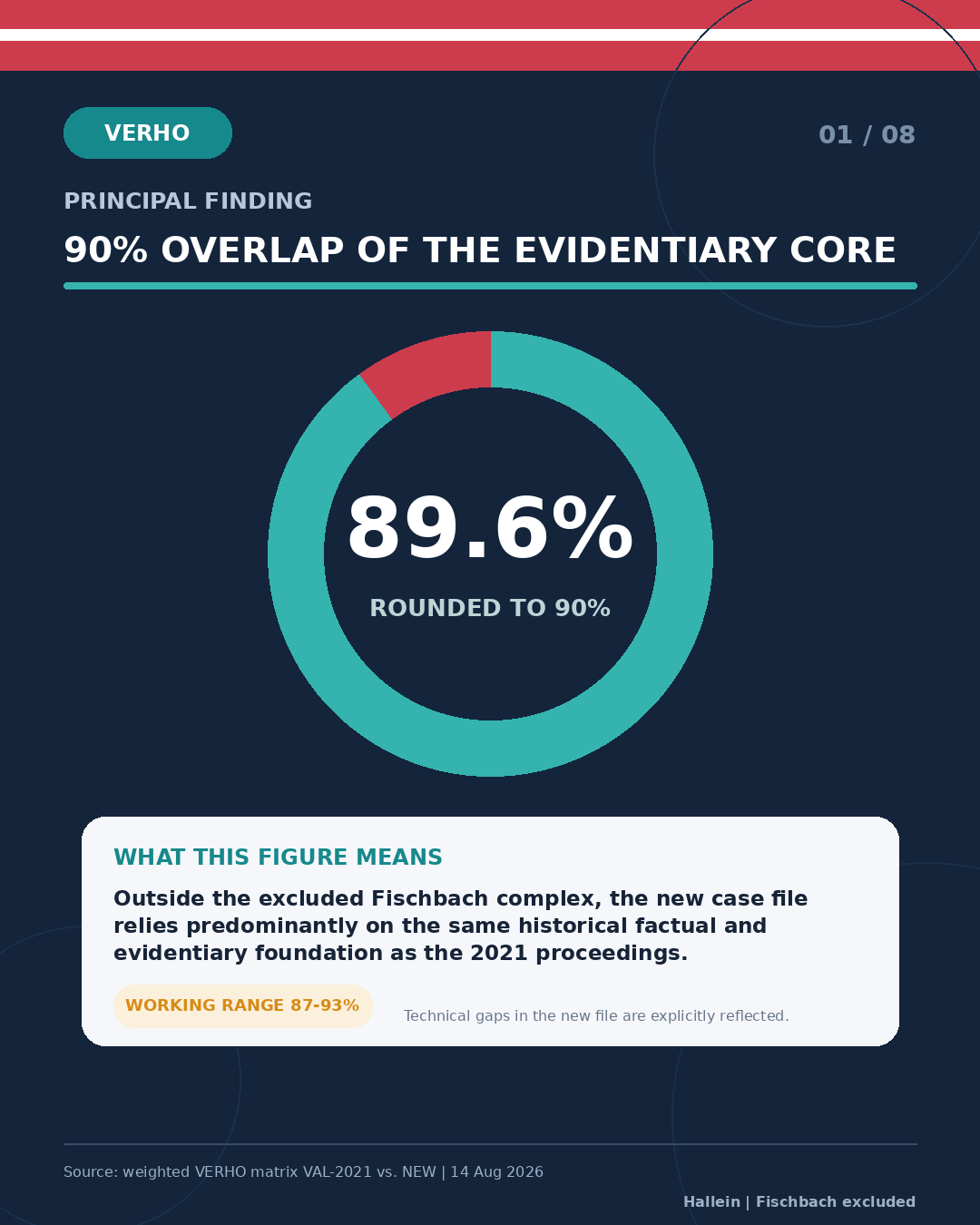
The figure of 89.6% is therefore not a subjective impression. It is the weighted sum of five separately examined comparison axes.
Because the new case file contains technical gaps and some attachments cannot be traced continuously, we also use a cautious working range of 87% to 93%.
Even at the lower end of that range, the conclusion remains clear: most of the historical evidentiary foundation is not new.
Seven out of eight objects contain an old core
In addition to the weighted calculation, eight central comparison objects were examined individually:
the Hallein complex,
1,2-dichloroethane,
measurements and analytical methods,
photographs of the containers,
the video dated 22 July 2020,
the roles of Holzknecht and Pawlik,
the acquittal and the state of knowledge at the time,
new recordings, recipients and communication acts.
Seven of these eight objects contain an identical or historically continuous core.
This represents 87.5% of the central comparison objects.
Only the eighth area contains a more substantial number of genuinely new elements. Those elements primarily concern:
new recordings,
later publication dates,
new recipients,
altered public reach,
individual new communication acts.
This distinction is fundamental.
What is new is primarily the carrier, timing, audience, reach and communication channel. The historical origin of much of the evidence and many of the statements remains unchanged.
Why the timing of the publications matters
The new publications appeared after the 2021 judgment. This chronology must be taken seriously.
A video published after an acquittal may constitute a new act of publication. No one disputes that a later publication is chronologically a new event.
But the date of publication does not answer whether the historical evidence used in that publication is also new.
If a later video uses:
the same photographs,
the same measurements,
the same chemical substances,
the same persons,
the same historical events,
or the same previously known documents,
the origin of that material does not change.
Put simply:
The video may be new. The evidence contained in the video may still be old.
This is where the new case file appears to blur an essential distinction. New files are treated as new procedural material even though they contain, to a substantial degree, evidence that formed part of the original proceedings.
A new upload date proves when a file was published. It does not prove when the underlying facts arose, when the evidence was first known or whether it had already been judicially examined.
A 90% overlap is not the same as ne bis in idem
An important legal distinction must be made.
The figure of 90% is an analytical result. It answers the following question:
To what extent do the old and new factual and evidentiary foundations overlap?
The principle of ne bis in idem, also known as the prohibition against double jeopardy, does not operate through percentages.
For each specifically defined historical allegation, the legal questions are different:
Does the new prosecution concern the same facts that were already finally adjudicated?
Or does it concern a genuinely distinct act?
There is no such thing as a 70%, 80% or 90% procedural bar. For each allegation, the final legal conclusion is essentially binary: the bar applies or it does not.
Our analysis therefore distinguishes between two separate findings:
90% describes the analytically measured degree of overlap between the two case files.
Three out of three refers to three specifically delimited historical allegations which, according to our document analysis, were already examined in the 2021 proceedings and ended in an acquittal.
A new video may constitute a new act of publication. But if the new proceedings once again prosecute one of the historical allegations that has already been finally adjudicated, the issue is no longer one of percentage-based similarity.
The relevant questions become factual identity, the scope of the previous judgment and the possible procedural bar created by that judgment.
A later publication date alone cannot answer those questions.
The questions the prosecution should be required to answer
This analysis is not a judicial decision. It does, however, create a clear and specific verification mandate.
For every new allegation, the following questions should be answered transparently:
1. What exactly is the new act?
Is only the publication new, or does the case also involve a genuinely new historical event?
2. Which evidence is genuinely new?
Was the evidence newly created or newly discovered, or is it merely an old item of evidence appearing in a new file?
3. Was the same factual allegation part of the 2021 proceedings?
If so, how was it assessed at the time, and what significance does the acquittal have for the new case?
4. What independent verification was carried out?
Were the submitted allegations independently examined? Were exculpatory materials considered? Were contradictions between the old and new files investigated?
5. Were the act of publication and the origin of the evidence properly separated?
A later upload establishes when a file was published. It does not automatically establish a new evidentiary origin.
Unless these questions are answered separately for every allegation and every item of evidence, the impression of extensive case-file recycling remains unavoidable.
Comparison with European VERHO-SLAPP patterns
In a separate study, VERHO examined 120 reference cases from 19 European states. The study used four validation levels and produced 252 pages of supporting documentation.
It examined recurring procedural mechanisms rather than the merits of one particular national legal system.
The result of that second matrix was a 95% common European core of recurring mechanisms.
One pattern appeared with particular frequency:
The originally reported wrongdoing gradually recedes into the background, while institutional and legal attention shifts towards the whistleblower, their statements and their publications.
The comparative values were:
Austria as the reference state: 91%,
Germany compared with Austria: 97%,
Switzerland compared with Austria: 96%,
other examined states compared with Austria: 93%.
These figures do not measure the quality of individual states. They measure the recurrence of particular procedural patterns.
It is equally important to understand that the 90% found in the concrete case-file comparison and the 95% identified in the European SLAPP analysis must not be added together or multiplied.
They measure two different objects:
90%: the overlap between the 2021 case file and the new proceedings;
95%: the recurrence of procedural mechanisms across the European reference cases.
Their convergence is nevertheless analytically significant.
The reuse of an old evidentiary core may operate in the same procedural direction identified by VERHO in its SLAPP research: the original reported problem loses visibility, while the whistleblower and their publications become the central subject of new proceedings.
This does not automatically classify the present case as a SLAPP proceeding. It does, however, constitute a warning signal that warrants independent examination.
The real issue is not the age of a file
The decisive distinction is this:
File identity is not evidence identity.
Two technically different files can contain the same historical evidence. Conversely, one file may document several genuinely separate events.
A serious criminal investigation cannot therefore stop at the filename, upload date or publication platform. It must trace every relevant item back to its origin:
When did the alleged event take place?
When did the evidence first become known?
Was it part of an earlier proceeding?
How was it assessed in that proceeding?
What has genuinely been added since the earlier judgment?
Only after these questions have been answered can anyone determine whether the new proceedings concern a new criminal allegation or an old allegation presented in new packaging.
Conclusion: Newly published does not mean newly proven
The VERHO analysis presents a consistent picture:
89.6% weighted overlap between the factual and evidentiary cores,
seven out of eight central comparison objects with an identical or historically continuous core,
three specifically identified historical allegations that were already examined in the 2021 proceedings and ended in an acquittal,
genuinely new elements found primarily in the carrier, timing, reach, recipients and individual communication acts.
This does not automatically establish that the entire new proceeding is legally inadmissible.
It does, however, raise a fundamental question:
Was a genuinely new factual event investigated — or was an already examined body of evidence reintroduced into criminal proceedings through new videos and later publication dates?
A legally sound answer cannot be given in general terms. It must be established separately for every allegation, every item of evidence and every historical event.
Because a new carrier can contain old evidence.
A later video can repeat an earlier allegation.
And a new case file cannot simply treat a final acquittal as though it had never existed.
Transparency notice: The percentages presented in this article are the results of a document-based VERHO comparison matrix and are not judicial findings. The Fischbach complex was excluded from this analysis in full. The legal assessment of factual identity, procedural bars and ne bis in idem remains the responsibility of the competent independent courts.