

Allegation Versus Reality: What Happened Before the Entry onto Private Property?

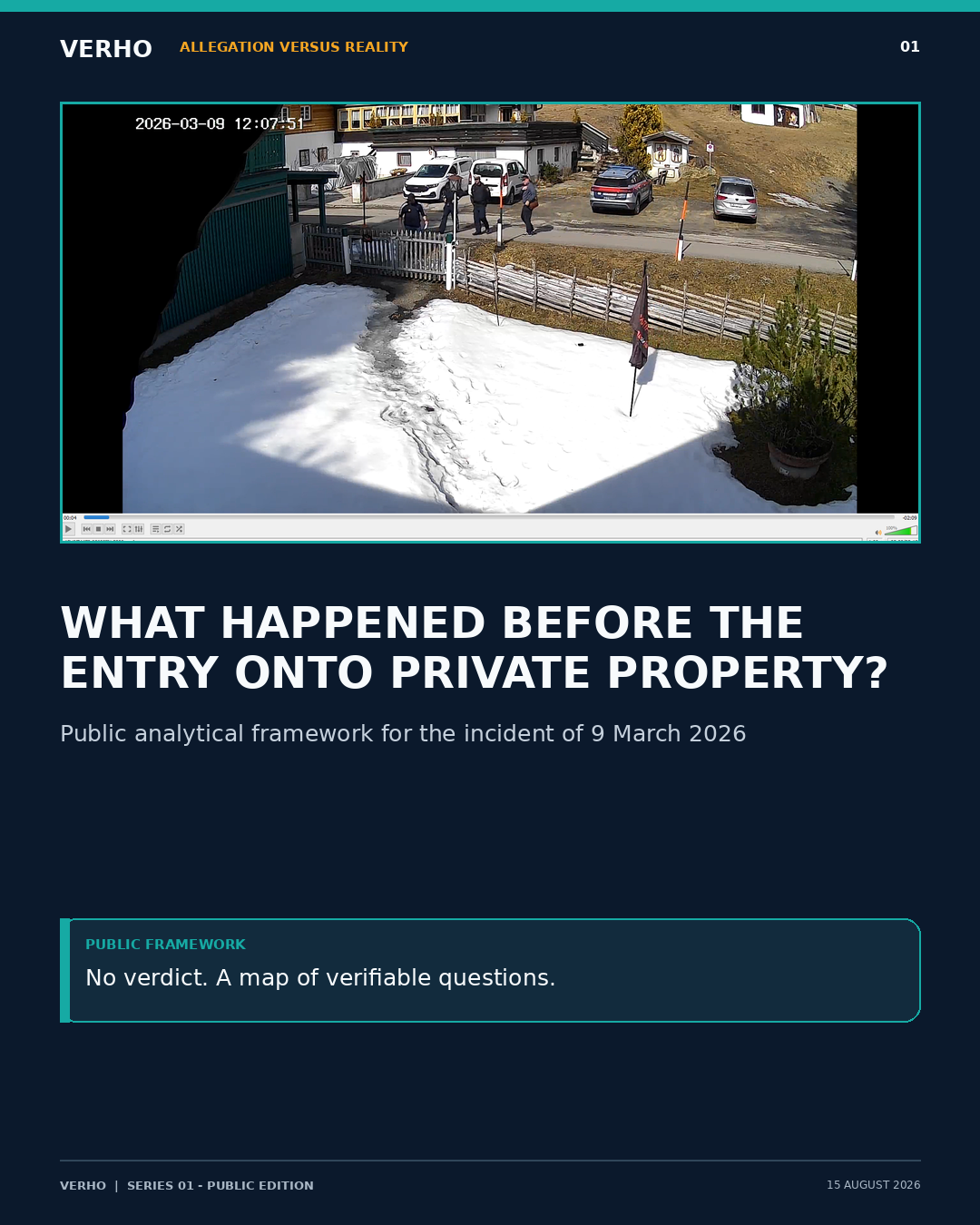
Allegation Versus Reality: What Happened Before the Entry Onto Private Property?
A new VERHO series examines how statements recorded in an official case file compare with the verifiable record
We have now obtained the complete case file concerning an incident that took place on 9 March 2026.
This marks the beginning of a new VERHO series in which we will examine individual statements contained in official records and compare them with what can actually be established from primary documents, images, timestamps and the applicable Austrian legal framework.
The purpose is not to replace a court, a lawyer or an investigative authority.
The purpose is much simpler:
To distinguish between what was asserted, what was documented, what can be independently verified and what remains an open question.
For evidentiary and privacy reasons, the public version deliberately presents only a limited selection of the available material. The complete technical and legal questions are set out in the accompanying PDF analysis.
What is VERHO?
VERHO is an analytical framework designed to organise complex case files and identify connections between allegations, evidence, procedural decisions and missing investigative steps.
The method separates five basic levels:
a documented fact;
an allegation contained in a document;
the original source of that allegation;
an independently verifiable contradiction or signal;
an open question that requires an additional primary source.
VERHO does not determine guilt or innocence. It does not describe a person, institution or authority as acting unlawfully merely because a contradiction has been identified.
It asks whether the explanation recorded in the file can be reconstructed from the underlying evidence.
In the present case, the first question is remarkably simple:
What happened before several persons entered private property on 9 March 2026?
The sentence contained in the official report
The report prepared by LKA Oberwart on 10 March 2026 contains the following sentence:
"Zu diesem Zweck wurde das Grundstück der Beschuldigten betreten, da auf 'lautes Rufen' keine Rückmeldung erfolgte."
A working English translation reads:
"For this purpose, the accused persons' property was entered because there was no response to loud calling."
This sentence is important because it establishes a causal sequence.
According to the report:
loud calling occurred;
there was no response;
the property was therefore entered.
If entry onto private property is explained by a lack of response to loud calling, the underlying sources should make that sequence verifiable.
The relevant questions are therefore not complicated:
What exactly was said?
Who said it?
Was the person identified as a police officer?
Was the purpose of the visit communicated?
How loudly and how many times was a call made?
Who personally heard it?
How much time was allowed for a response?
Who decided that there had been no response?
Who then decided that entry onto the property was necessary?
The existence of the sentence in the report is a documented fact.
The accuracy of the sentence, however, cannot be established merely by repeating it in later documents.
What can a photograph prove?
A photograph can show the presence of people, their position, their clothing and the direction in which they appear to be moving.
It cannot, by itself, establish:
the words that were spoken;
the volume at which they were spoken;
whether anyone identified themselves as a police officer;
whether the purpose of the visit was explained;
the number of calls;
the length of the waiting period;
an operational instruction;
the legal authority for entering or moving across the property.
A photograph preserves one moment. It does not automatically preserve the complete event.
The publicly selected images show several persons near the entrance to the property. Later images show movement beyond the immediate gate and service area, including movement towards the residence and its side area.
That does not automatically prove that a search of the dwelling took place.
It does, however, create a legitimate and verifiable question:
If the declared purpose of the operation was only the service of two summonses, what concrete reason justified movement beyond the immediate place of delivery?
Entry and movement are not automatically a house search
Terminological precision is essential.
Entering private property is not necessarily equivalent to conducting a house search. Standing near a window or moving along the side of a building does not, by itself, prove a systematic search.
For that reason, the public VERHO analysis does not claim that a house search occurred.
Instead, it asks for the primary documents capable of establishing:
the purpose of the operation;
the tasks assigned to each participant;
the person directing the operation;
the authorised operational scope;
the legal basis for entry;
the reason for movement beyond the direct route of service.
Clothing must be treated with the same caution.
A cap, dark glasses or civilian clothing are not prohibited as such. They neither prove nor disprove official authority.
The legally relevant question is whether the person's official role was recognisable while powers were being exercised or whether that role was properly demonstrated when required.
Why were the criminal police used for service?
Section 82(3) of the Austrian Code of Criminal Procedure provides that the criminal police should be requested to serve documents only where this is absolutely necessary in the interests of criminal justice.
This does not mean that police service is automatically unlawful.
It does mean that the file should answer several basic questions:
Who ordered service through the criminal police?
Why was police service considered absolutely necessary?
Was that necessity recorded?
Which form of service was ordered?
Who was identified as the formal recipient?
What operational measures were authorised?
Without the original written or electronic service instruction, these questions cannot be answered reliably.
The official text of Section 82 StPO is available in the Austrian RIS.
The defence was already known before 9 March
The documentary chronology does not begin on the day of the incident.
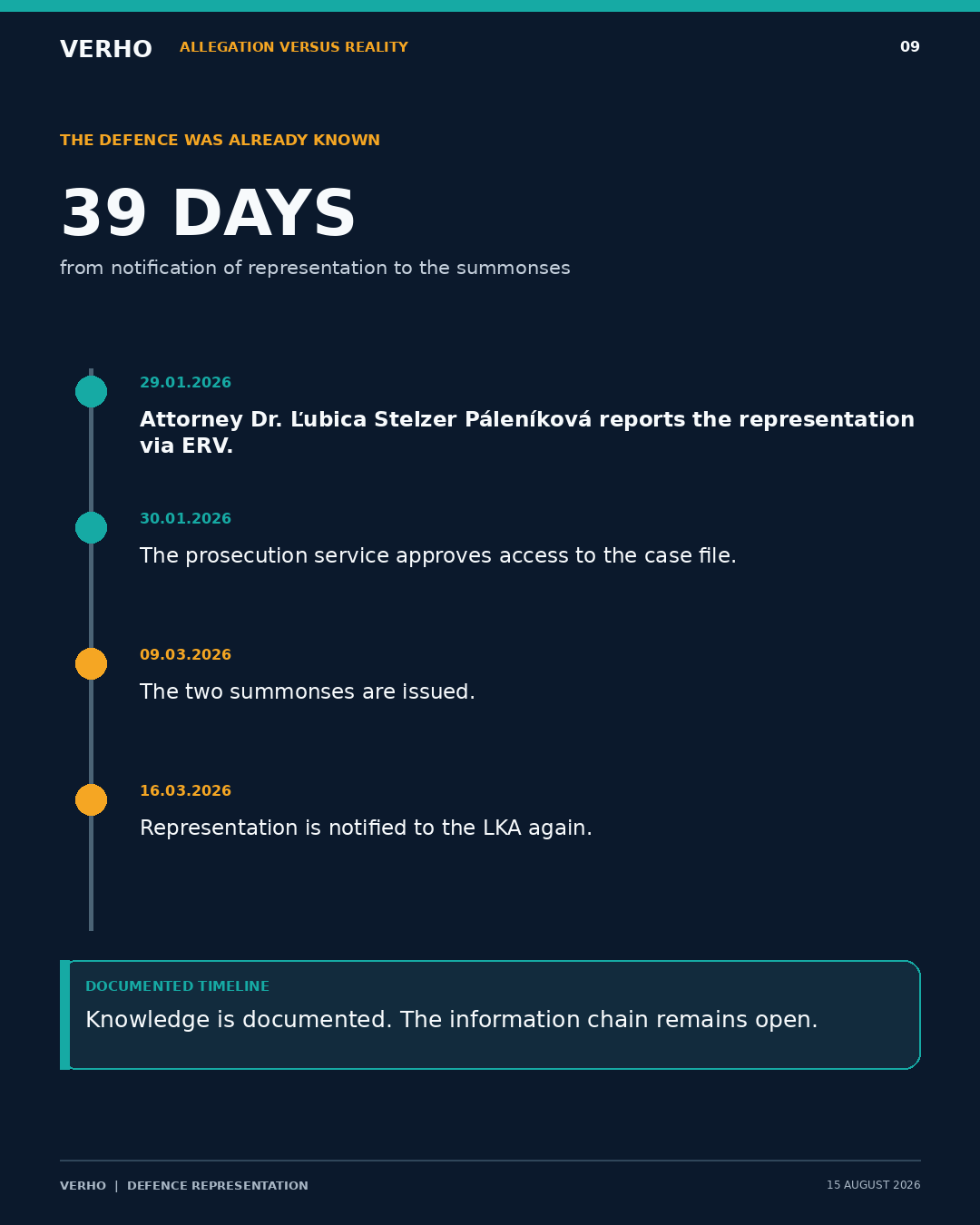
On 29 January 2026, attorney Dr. Ľubica Stelzer Páleníková informed her clients that she had submitted, through Austria's electronic legal communication system, a notice of representation and a request for digital access to the case file.
On 30 January 2026, the Eisenstadt Public Prosecutor's Office approved access to the case file in proceeding 8 St 101/24k.
The official approval expressly identified Dr. Ľubica Stelzer Páleníková as the representative of Michaela Povalová.
The two summonses were issued and their personal service was attempted on 9 March 2026.
On 16 March 2026, counsel again informed LKA Oberwart that she represented both accused persons, enclosed the powers of attorney and referred to the earlier notification of 29 January.
The chronological distance is significant:
39 days elapsed between the notification of representation on 29 January and the operation of 9 March;
38 days elapsed between the approval of file access on 30 January and the operation of 9 March.
The defence was therefore not first announced only after the incident.
At least in relation to Michaela Povalová, the prosecution service's knowledge of the representation is directly documented by an electronically signed official decision.
For Pavol Pribela, the available chain is supported by the communication of 29 January and counsel's letter of 16 March. The complete ERV filing, transmission protocol and attached powers of attorney remain necessary to establish that part of the chain with the same evidential strength.
Personal attendance is not the same as personal-only service
A central distinction must be made between two different legal questions:
whether an accused person may be required to attend questioning personally;
on whom the summons must formally be served when defence representation has already been notified.
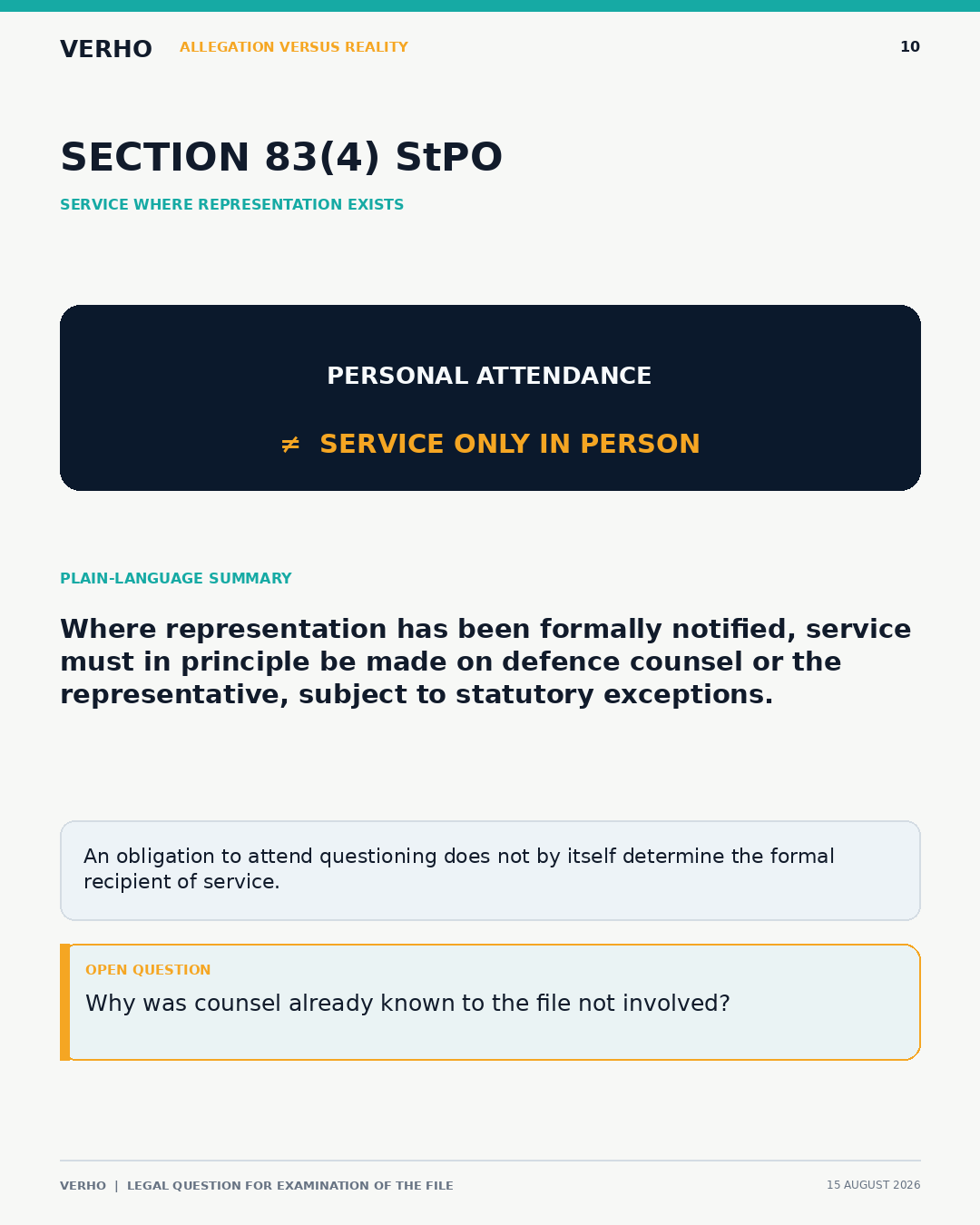
A summons may require the accused person's personal attendance.
That does not automatically mean that the document may be served only on the accused person while already notified defence counsel is bypassed.
Section 83(4) StPO provides, in principle, for service on defence counsel or another formally notified representative where representation exists, subject to the exceptions in which the law requires personal service.
The official text of Section 83 StPO is available in the Austrian RIS.
The documents therefore create a prima facie contrast:
The defence was already known and processed in the case file, yet the summonses appear to have been served directly on the accused persons without prior involvement of counsel.
This does not automatically invalidate the summonses or the entire proceeding.
The correct legal consequence depends on additional questions, including:
the precise form of service ordered;
whether personal service was legally required;
whether defence counsel actually received the documents;
whether any defect was subsequently cured;
whether concrete procedural prejudice resulted;
which remedy is available under Austrian procedural law.
The public analysis therefore makes no final declaration of invalidity.
It asks why already documented representation was not taken into account.
Where did the information disappear?
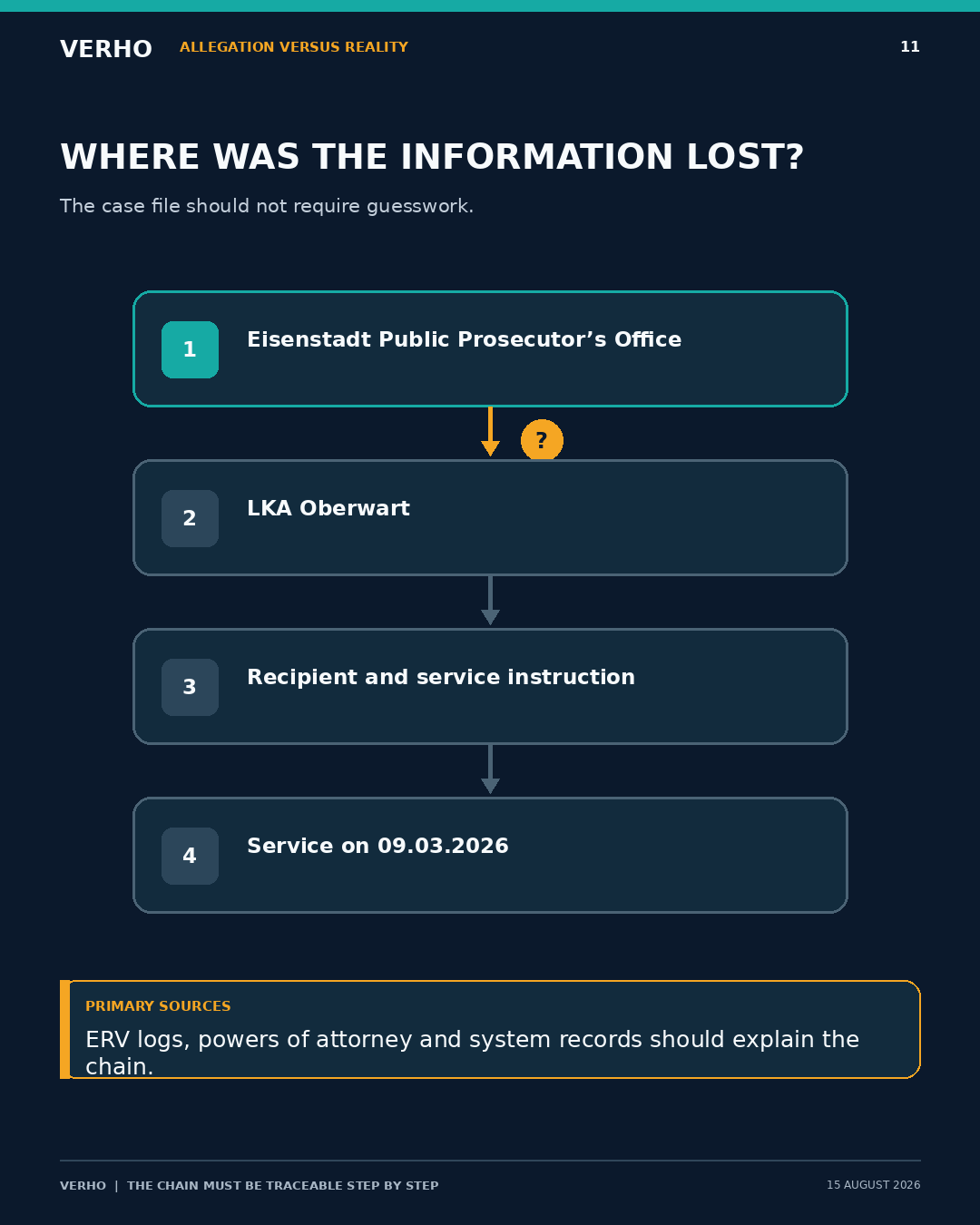
The available documents reveal a second analytical problem: the information chain.
The relevant chain appears to have involved at least:
the Eisenstadt Public Prosecutor's Office;
the electronic case-file or ERV system;
LKA Oberwart;
the persons preparing the summonses;
the persons instructed to carry out service.
If representation was recorded and file access had already been approved, one of several possibilities must be examined:
the prosecution service did not transmit the information;
the information was available but was not consulted;
the LKA received incomplete information;
the service instruction identified the wrong recipient;
a conscious decision was made to use a different method of service;
the representation status was recorded inconsistently in different systems.
At present, the publicly available documents do not establish which of these explanations is correct.
That is why system logs, transmission records and the original service order are more important than speculation.
The phrase "lautes Rufen" must have an identifiable source
Section 95 StPO requires relevant statements and significant official events to be recorded in a manner that makes their substance verifiable.
The expression "lautes Rufen" should therefore be traceable to a primary source.
Who personally perceived the alleged loud calling?
Was the phrase based on:
the direct perception of the report's author;
a statement made by another participant;
a collective reconstruction after the operation;
an audio recording;
a contemporaneous operational note;
a later description?
If subsequent documents merely repeat the same phrase, they do not constitute independent confirmation.
Repetition does not transform one allegation into several independent pieces of evidence.
The analysis must return to the first source.
Ten questions the case file should answer
The case file should make it possible to answer the following questions without speculation:
What exactly was said before the first entry onto the property?
Was it a greeting, a request, a loud call, identification as police or a combination of these?
Who spoke, and who personally heard the words?
Who first described the communication as "lautes Rufen"?
How many calls were made and how much time was allowed for a response?
Who decided that there had been no response and that entry was necessary?
Who ordered service through the criminal police, and how was its absolute necessity documented?
What tasks were assigned to the individual participants?
Why was defence counsel already known to the file not involved?
At which point in the prosecution-LKA information chain was the representation lost or not considered?
Each answer should identify an original document, system log, recording or person with direct knowledge.
What VERHO is not claiming
The public analysis does not claim that:
the photographs alone prove an unlawful entry;
a house search definitely took place;
wearing civilian clothing, a cap or dark glasses was unlawful;
the identified service issue automatically invalidates the criminal proceeding;
the available material already answers every legal question.
The analysis identifies contradictions and evidentiary gaps that require clarification.
That is an important distinction.
A legal conclusion must follow the evidence. The evidence must not be reshaped to fit a conclusion chosen in advance.
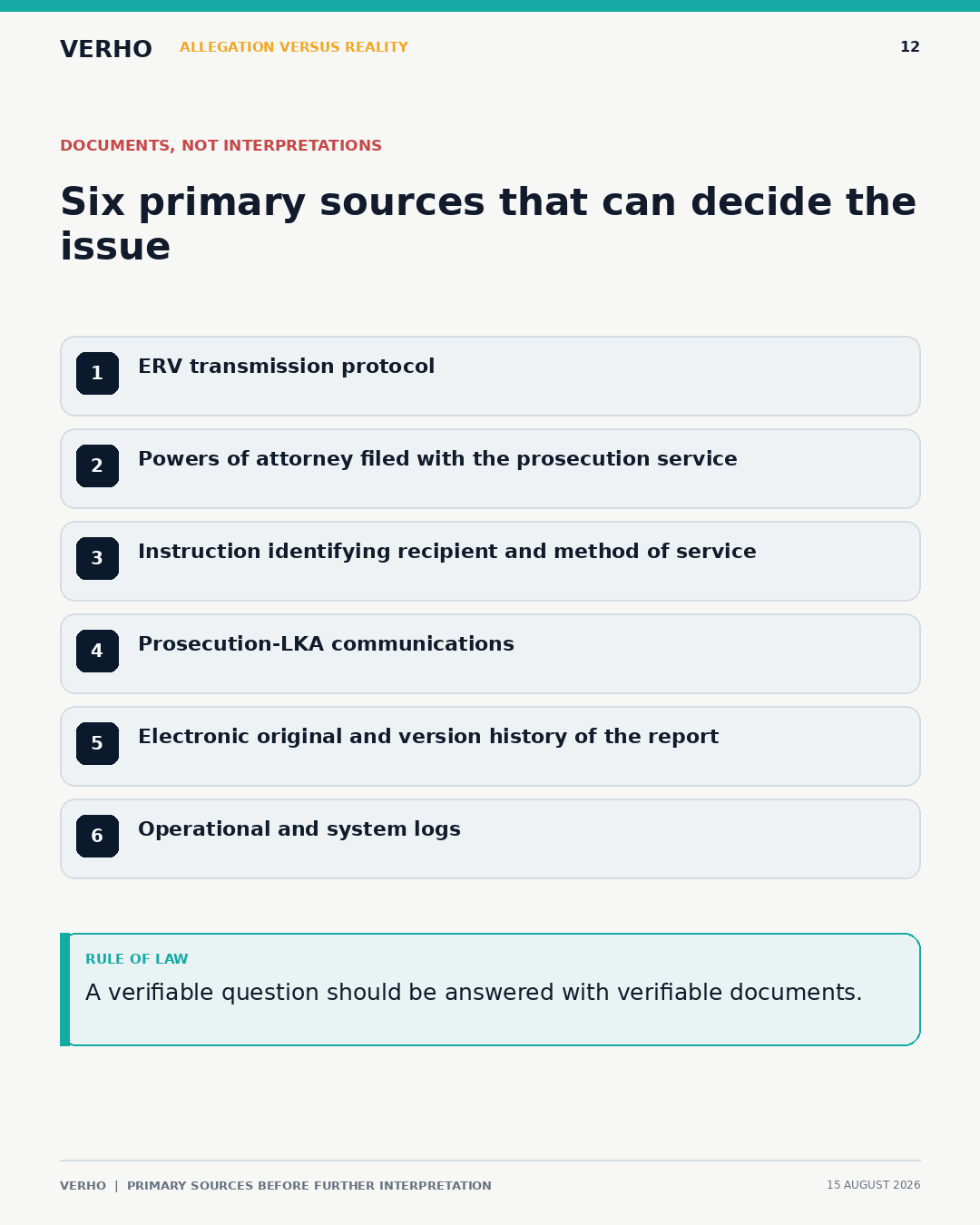
Primary documents that can resolve the issue
The open questions can be resolved primarily through documents already expected to exist within the relevant institutional systems:
the original written or electronic service order;
the reason why police service was considered absolutely necessary;
the ERV filing of 29 January 2026;
its transmission protocol and attachments;
the powers of attorney for both accused persons;
the prosecution service's access and processing logs;
the LKA's consultation and operational logs;
the complete summonses, including every page and approval trace;
the list of participants and their assigned functions;
the original electronic report and its version history;
the identity of the person who directly perceived the alleged loud calling;
the legal authority recorded for entry and movement beyond the direct route of service.
These sources can provide answers without attributing more to individual photographs than they actually show.
Two independent issues remain
The public VERHO assessment identifies two separate evidentiary cores.
The first concerns the factual sequence:
Was there clear and audible calling before entry, and can that sequence be demonstrated by a primary source?
The second concerns the procedural chain:
Why was defence representation already known and processed by the prosecution service not taken into account when the summonses were prepared and served?
Neither issue is resolved by repeating the wording of the original report.
Both require the underlying documents.
Documents, not interpretations
The accompanying English PDF sets out the available chronology, selected images, legal framework, evidentiary limits and open questions in a structured form.
It contains clickable links to the official Austrian legal sources and redacted excerpts from the documents concerning defence representation.
Readers can therefore verify what is documented, what is merely asserted and what remains unanswered.
This is the purpose of VERHO:
Verification. Evidence. Reconstruction. Hypotheses. Open questions.
Not a predetermined conclusion.
Not a personal attack.
A transparent comparison between the statement in the file and the sources on which that statement should stand.